

In January 2026, the way businesses communicate is undergoing a massive shift. The global VoIP market is valued at approximately $162 billion in 2025 and is projected to grow at over 11%, reaching towards $415 billion by 2034. Meanwhile, traditional Public Switched Telephone Network (PSTN) landlines are in steady decline—global fixed voice subscriptions dropped in recent years, with major providers phasing out copper networks entirely by 2027 in many regions.
If you’re still relying on legacy phone lines, it’s time to compare them head-to-head with modern VoIP systems. This guide breaks down the key differences to help enterprises make an informed decision.
Table of Contents
Break Down Between VoIP & Phone Lines
Traditional phone lines (PSTN) use circuit-switching technology, a dedicated physical copper wire creates an end-to-end connection for the duration of the call. This has been reliable since the late 1800s but is inefficient for data.
VoIP, on the other hand, uses packet-switching that your voice is digitized, compressed into packets, and sent over the internet like any other data. This allows for multimedia (voice + video + messaging) on the same connection.
Here’s a visual comparison of the technologies:
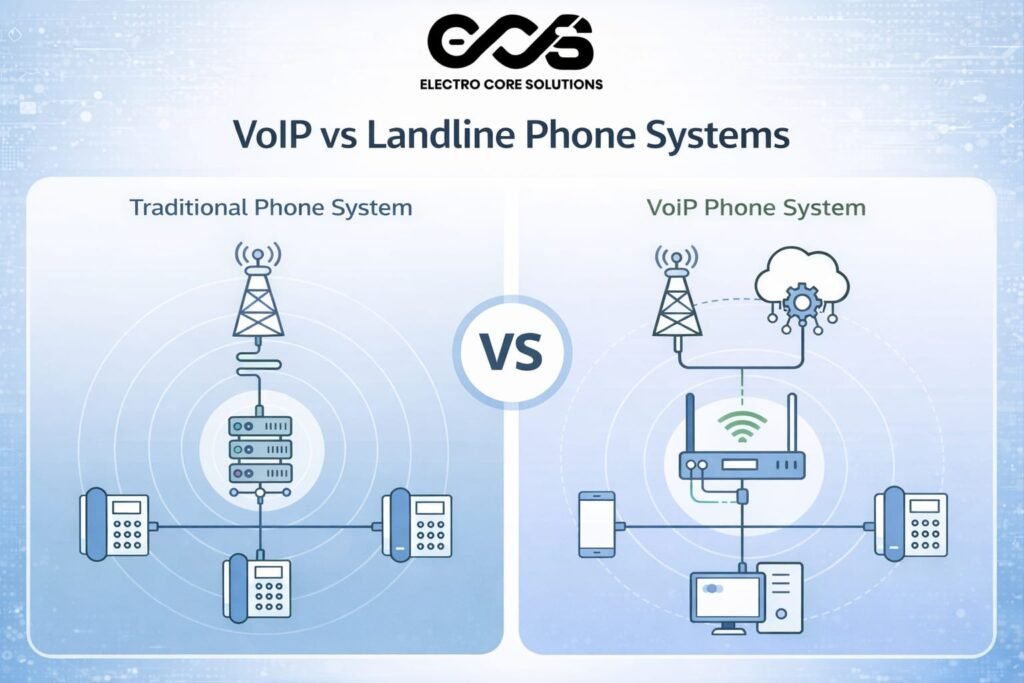
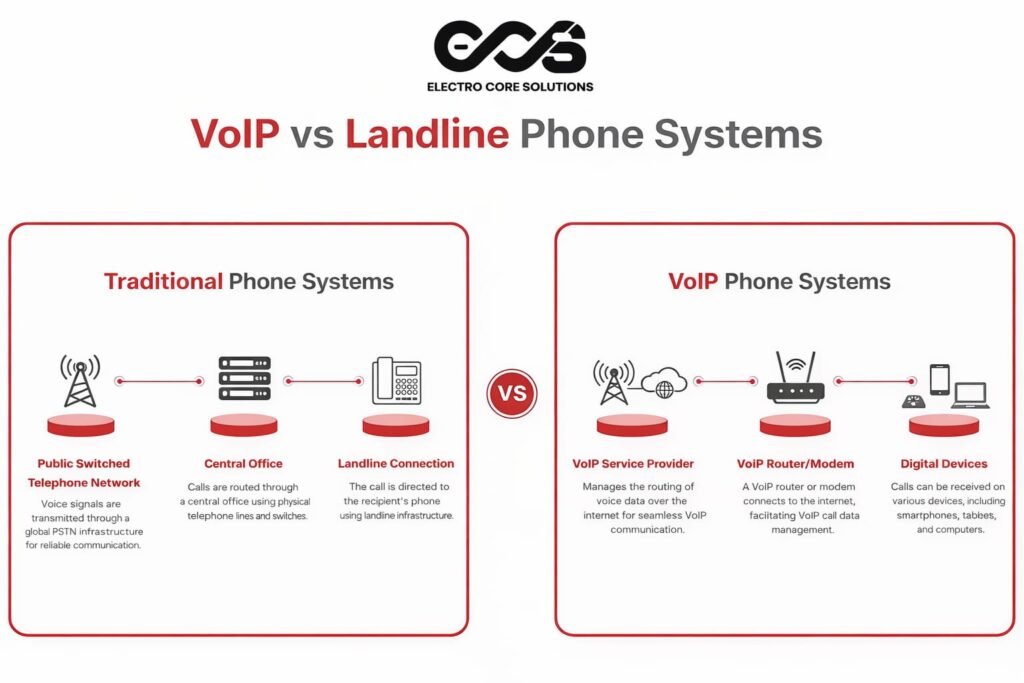
The shift to VoIP enables seamless integration of voice with digital tools, making it far more versatile.
Why VoIP Often Saves Businesses 30-50% or More
Cost is where VoIP shines brightest. Businesses switching to VoIP typically save 30-50% on monthly bills, with some reporting up to 75% reductions—especially on international and long-distance calls, which are often free or flat-rate.
Traditional landlines involve high setup fees for wiring, separate charges per line, per-minute billing, and expensive maintenance. VoIP leverages your existing internet, with cloud plans starting low and scaling predictably.
Real-world example: A mid-sized enterprise with global clients can cut international call costs by 90%. No wonder 85% of organizations are projected to go cloud-first by now.
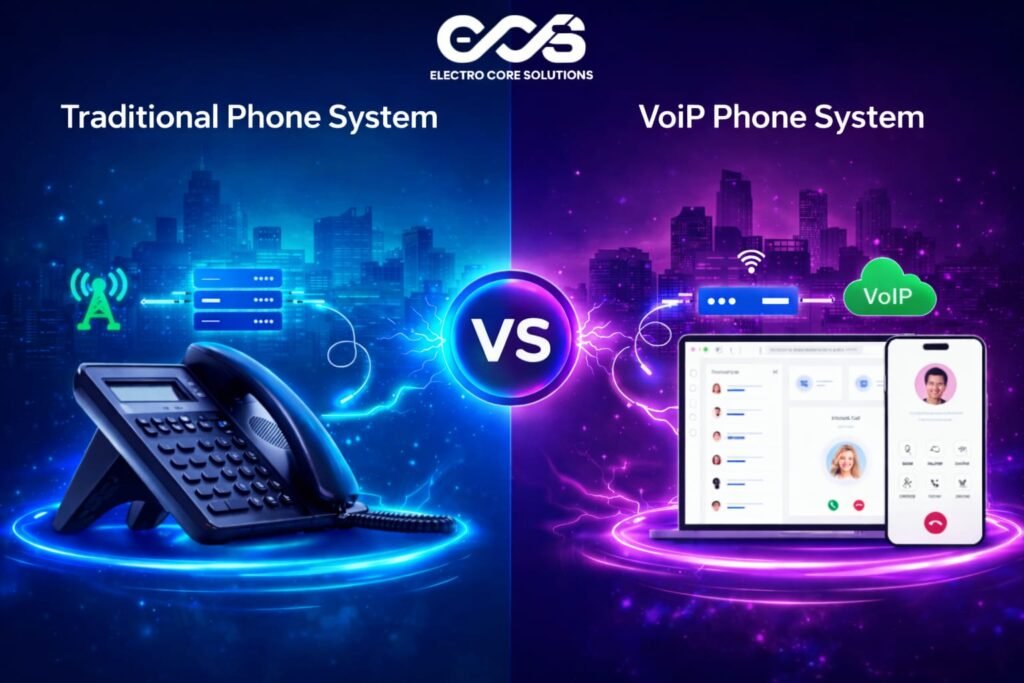
Traditional landline desk phone vs. modern IP phone:
Adding Lines in VoIP vs. Physical Installations in Landlines
Need to add 10 new employees? With PSTN, that means scheduling technicians, running new wires, and paying for hardware—days or weeks of downtime and high costs.
VoIP? Log into your admin portal and add users in minutes. No physical changes required. This digital scalability is perfect for growing businesses or those with fluctuating seasonal needs.
Mobility and Remote Work Support: VoIP's Anywhere Access vs. Fixed Landlines
Hybrid and remote work is the norm in 2026. VoIP empowers employees to use their business number on laptops, mobiles, or tablets—from anywhere with internet.
Traditional landlines tie you to a desk or office location. Forwarding calls incurs extra fees and complexity.
Remote workers thriving with VoIP:

This mobility boosts productivity and employee satisfaction significantly.
Advanced Features: Video Conferencing, Integrations, and More in VoIP
Landlines offer basic calling—maybe voicemail or call waiting if you’re lucky.
VoIP packs in HD voice, video calls, screen sharing, team chat, AI transcription, call analytics, and more—often at no extra cost.
Enhanced collaboration through integrated video conferencing:

These tools turn communication into a productivity powerhouse.
Call Quality and Reliability
Traditional lines offer consistent quality because they’re dedicated circuits—immune to internet fluctuations.
Modern VoIP, however, delivers superior HD voice with advanced QoS (Quality of Service) protocols. Jitter and lag are minimal on good broadband, and failover options ensure uptime rivals landlines.
In 2026, with widespread high-speed internet, VoIP quality often exceeds analog.
Security Considerations
PSTN is inherently secure—no data packets to intercept—but it’s outdated and vulnerable to physical tapping.
VoIP uses robust encryption (SRTP/TLS), firewalls, fraud monitoring, and compliance features (GDPR/HIPAA).
The Ultimate Guide to VoIP Security & Encryption (Updated)
When properly configured, VoIP is more secure than legacy systems.
Emergency Services and Power Outages
Landlines work during power outages (powered by the exchange) and provide precise location for 911 calls.
VoIP depends on electricity and internet; outages can disrupt service. However, modern providers offer E911 with accurate location and battery backups mitigate this.
This is one area where PSTN retains a slight advantage, especially in rural zones.
Current Market Trends and Adoption Statistics in 2026
Over 65% of global enterprises use VoIP, with adoption surging among SMEs. PSTN subscriptions continue declining as carriers phase out copper (e.g., full switch-off in many countries by 2027).
Remote work has accelerated this: VoIP powers hybrid teams seamlessly.
Why VoIP is Replacing Traditional Networks Worldwide
While traditional phone lines served us well for decades, VoIP outperforms them in cost, features, scalability, and innovation. In 2026, the choice is clear for most businesses: VoIP delivers superior value and prepares you for tomorrow’s AI-driven communications.
Ready to migrate and experience these benefits firsthand? Contact the experts at Electrocore Systems to assess your needs and design a custom VoIP solution. We’ll guide you through a smooth transition—get in touch today!
Frequently Asked Questions
VoIP turns voice into digital data packets that travel over the internet using a method called packet-switching. This allows it to work with voice, video, chat, and other types of media all in one system. Traditional PSTN (Public Switched Telephone Network) or landlines use a different method called circuit-switching, which sets up a fixed, direct connection between two points using copper wires. This means the line is dedicated to the call for its entire duration. VoIP is more flexible and efficient for today’s digital needs, while PSTN is dependable but only supports basic voice calls and uses older, outdated infrastructure.
VoIP is much more cost-effective, often saving businesses 30–50% (sometimes up to 75% or more on international or long-distance calls) by removing the need for expensive hardware, line fees, setup costs, and maintenance of copper wiring.
Traditional landlines charge high monthly fees, require physical installation, and are becoming more expensive as carriers gradually stop supporting PSTN (full copper shutdowns are expected by 2027 in many areas). VoIP offers flat-rate plans and free internal or global calls, and businesses often see a return on investment in just a few months.
Ready to calculate your potential savings?
Contact Electrocore Systems for a free VoIP cost analysis tailored to your business—visit our IP Voice & Video Telephony page or reach out today!
VoIP is very scalable: you can quickly add or remove users or extensions through an admin portal without needing any physical changes, making it ideal for growing companies, multi-site operations, or businesses with changing needs.
It also supports full mobility—use your business number on laptops, mobile devices, or tablets from anywhere with an internet connection, which is great for hybrid or remote teams. Traditional landlines require costly wiring, technician visits, and hardware upgrades for new lines, and they are tied to fixed office locations with extra fees for call forwarding.
Modern VoIP offers high-quality HD voice with advanced QoS (Quality of Service) protocols, minimal jitter or lag on reliable broadband, and failover options for better uptime.
While traditional PSTN provides consistent performance via dedicated circuits (which don’t rely on the internet), VoIP often outperforms it on good connections and includes features like automatic redundancy. In 2026, with widespread high-speed internet and 5G coverage, VoIP reliability is likely to match or even exceed PSTN for most businesses.
Concerned about quality in your setup?
Our experts at Electrocore Systems can assess your network and recommend optimized VoIP solutions—schedule a free consultation now!
Traditional landlines have an advantage here: they usually work during power outages because they are powered by the phone exchange and can provide precise location details for emergency services (like 911 or E112).
VoIP relies on electricity and internet access, so service can be disrupted during outages. However, modern providers offer E911 with accurate location registration, battery backups, and failover to mobile networks. For most businesses in 2026, these precautions make VoIP fully viable, especially with proper planning.
Need a reliable, compliant VoIP setup for your organization?
Electrocore Systems specializes in secure, enterprise-grade migrations with emergency features built-in. Get in touch via our contact form or explore our UC-IPPBX & Contact Centre Solutions—let's discuss your requirements today!