

In a time when security threats are getting more complex, old ways of watching over places and stopping intrusions are not enough anymore. That’s where Artificial Intelligence (AI) comes in. AI is changing how we protect homes, offices, and public areas by using machine learning, computer vision, and data analysis. These technologies make security systems more intelligent, quicker, and better at stopping problems before they happen. AI can spot dangers as they happen and predict possible threats, turning security from just watching into actively stopping threats.
Picture a system where cameras not only record what’s happening but also check everything in real time, catching strange activities before they turn into actual problems. Think of security systems that learn from past events to guess when a break-in might happen, which cuts down on false alarms and helps respond faster. This isn’t just something from a movie—it’s happening now with AI-powered security systems.
According to experts, these AI systems can cut down false alarms by up to 90% and greatly improve how well they find real threats. As new kinds of cyber and physical attacks come up, AI’s ability to look at huge amounts of data quickly is becoming essential. This blog looks at how AI is making surveillance and intrusion detection better. It covers the main uses, the advantages, and what the future might hold. Whether you’re in security, run a business, or love technology, knowing about these changes can help you understand why smart security solutions are becoming so important.
Table of Contents
AI's Role in Revolutionizing Surveillance Systems
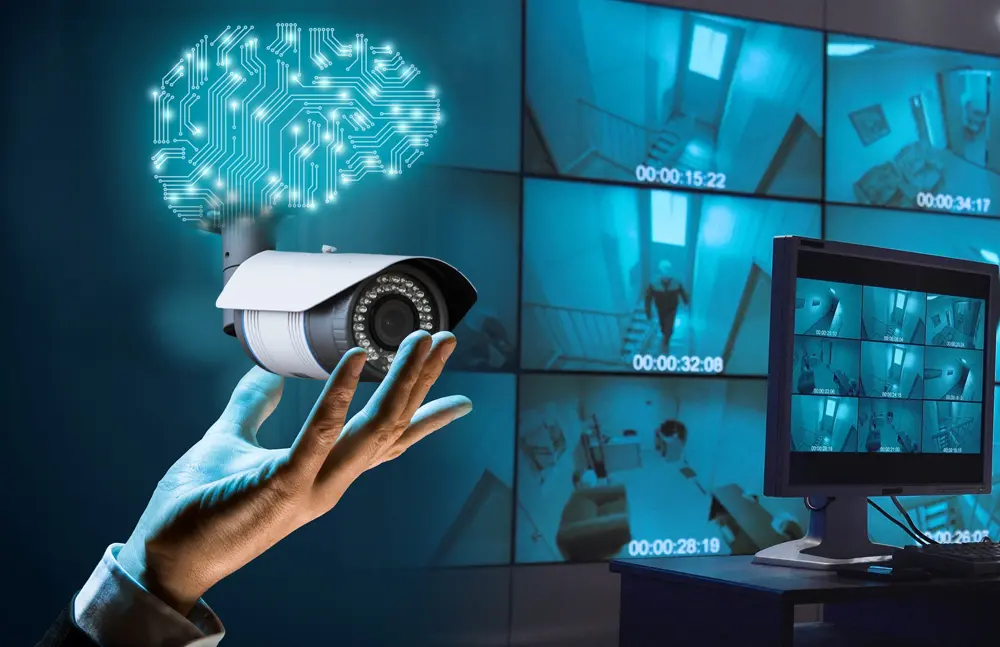
Surveillance has evolved a lot from the old days when we had low-quality CCTV videos that were only checked after something happened. AI takes this a step further by adding smart features directly into cameras and monitoring systems. One key way AI improves surveillance is through advanced video analysis. These systems use deep learning methods, like convolutional neural networks (CNNs), to process images and videos as they happen. They can spot objects, track movement, and understand behaviors in real time.
For example, AI can tell the difference between a friendly animal walking through a fence and someone trying to break in, which cuts down on false alarms that used to be a big issue with traditional setups. Facial recognition, made possible by AI, can instantly match faces against lists of people to watch, making security more efficient in places like airports or corporate buildings. During the pandemic, AI tools were updated to check if people were wearing masks and if they were standing too close to others, showing how flexible these systems can be when new challenges arise.
Another advantage is edge AI, where the processing of data happens right on the device instead of in the cloud. This makes the system faster, which is really important in situations like stopping shoplifting or monitoring busy city streets where quick responses are needed. In businesses, AI-powered surveillance handles routine tasks so that human workers can focus on bigger decisions. In smart cities, AI cameras watch traffic to spot accidents or strange behavior and work with police to respond quickly.
AI also helps with prevention by spotting threats before they become a problem. By looking at past data, these systems can find unusual activities, like someone hanging around a restricted area, and alert authorities early. This change from just reacting to things happening to predicting potential issues makes surveillance more efficient and helps stop crimes before they happen. However, the success of these systems depends on having good quality training data to avoid unfair or biased outcomes, ensuring they work fairly in different settings.
AI-Powered Intrusion Detection: From Detection to Prevention
Intrusion detection systems (IDS) have usually used rule-based alerts, which often don’t work well against new kinds of threats. AI changes this by using machine learning to learn from data, helping find unusual activities that don’t fit normal patterns. In network security, AI looks at traffic flows, packet data, and user behavior to spot intrusions like zero-day attacks or unauthorized access attempts.A big use of AI is in Intrusion Detection and Prevention Systems (IDPS), where it helps block threats as they happen. In physical security, AI works with sensors and cameras to watch perimeters, using behavioral analysis to detect intrusions. Voice and biometric recognition also help strengthen these systems, adding features like gait analysis to make identification more accurate.
In cybersecurity, AI is great at finding malware by looking for patterns in large datasets, catching even small ransomware attacks before they get through. Tools like Security Information and Event Management (SIEM) systems are made better with AI, helping to collect logs and unstructured data for a full view of threats. This automation also helps in incident response, where AI can isolate infected devices and start backups, reducing damage.
Edge AI improves intrusion detection in places that are far away or have limited internet speed, by processing data locally to keep things private and efficient. For large companies, this means fewer false alarms—AI systems learn over time and get better at recognizing real threats in their environment. In homes, AI cameras can stop package theft by noticing people lingering around deliveries and sending alerts right away. Combining AI with IoT devices creates connected systems where smart locks, alarms, and cameras work together for better protection. However, it’s important to keep training these systems to stay ahead of new threats, as hackers also use AI to carry out more advanced attacks.
Benefits, Challenges, and Future Trends
The benefits of AI in security are manifold. It processes massive data volumes at speeds unattainable by humans, enabling early threat detection and reducing operational costs. Enhanced accuracy cuts down on false alarms, freeing security teams for critical tasks. Predictive capabilities shift security from reactive to preventive, potentially averting incidents altogether. In terms of scalability, AI systems handle growing data from expanding surveillance networks without proportional increases in manpower.
However, challenges persist. Privacy concerns arise with facial recognition and data collection, necessitating robust regulations like GDPR. Biases in AI training data can lead to discriminatory outcomes, requiring diverse datasets. Additionally, the risk of AI being hacked or manipulated by adversaries calls for secure implementations.
Looking ahead, future trends include deeper integration with quantum computing for unbreakable encryption and AI-driven autonomous response systems. As AI evolves, expect more ethical frameworks to balance innovation with rights protection.
Conclusion
AI is not just enhancing security surveillance and intrusion detection—it’s redefining them. By making systems intelligent, proactive, and efficient, AI addresses the limitations of traditional methods, offering a robust shield against modern threats. From video analytics to anomaly detection, the technology empowers users to stay ahead in an increasingly complex security landscape.
As adoption grows, the focus must remain on ethical use and continuous improvement to mitigate risks. Ultimately, AI’s potential to create safer environments is immense, promising a future where security is seamless and intelligent. Embracing these advancements today will pave the way for a more secure tomorrow. Contact Electrocore Systems today and experience connectivity that drives real results.