

Not every business is ready to rip out its phone system and start over. Most Indian offices still have working analog handsets, an existing PBX, and a fax line or two that nobody wants to touch – yet they also need the cost savings and flexibility that come with IP-based voice. VoIP gateways and Analog Telephone Adapters (ATAs) exist to solve exactly that tension, letting legacy hardware and modern IP networks work side by side instead of forcing an all-or-nothing switch.
Table of Contents
What VoIP Gateways and ATAs Actually Do
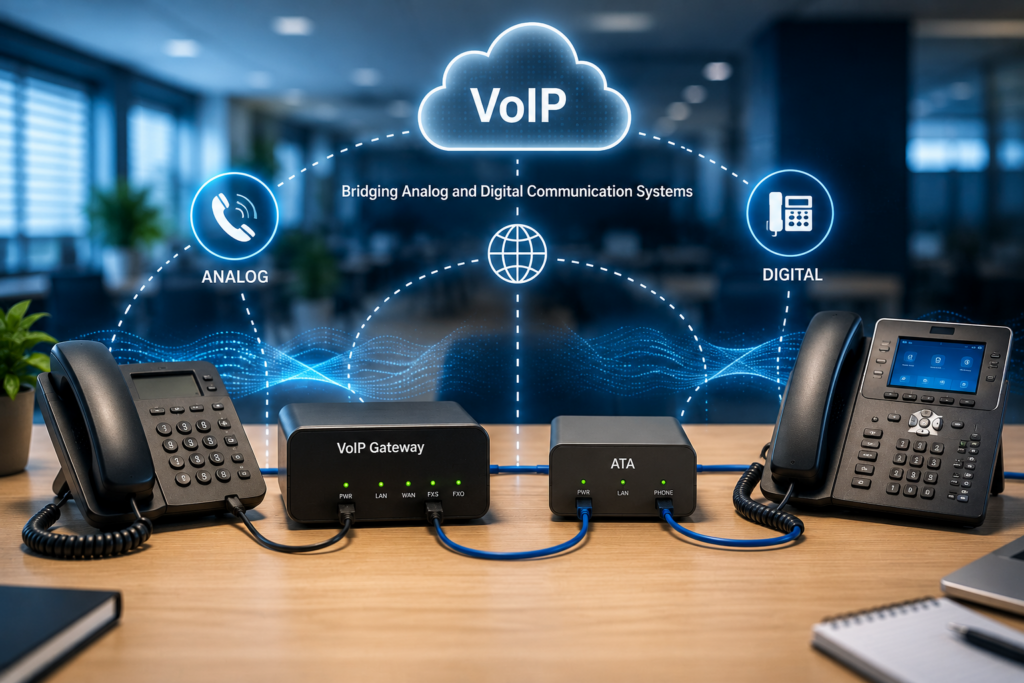
A VoIP gateway is a hardware device that sits between your existing telephony infrastructure and your IP network, converting analog or digital voice signals into IP packets (and back again) so the two systems can understand each other. Depending on the model, a gateway can interface with FXO/FXS analog lines or PRI/BRI digital trunks, which means it can bridge almost any legacy PBX to a SIP-based platform.
An ATA does a smaller, more focused version of the same job. It’s a compact adapter that lets a single analog phone, or a small group of them, register on a VoIP network without replacing the handset itself. Plug the ATA into your existing phone and your internet connection, and that phone can now make and receive calls over IP — no new hardware, no retraining staff on a new device.
Together, gateways and ATAs extend the useful life of telecom investments a business has already made, while still opening the door to cloud-based calling, centralized management, and the scalability that IP communication offers.
Why This Bridging Layer Matters Right Now
The shift toward IP-based voice isn’t slowing down. India’s VoIP services market is being shaped by enterprise digitization mandates, public-sector broadband expansion, and a structural shift of business communication toward IP-based infrastructure, with government-backed connectivity programs materially expanding the base of businesses that can realistically adopt VoIP. At the same time, the Asia Pacific VoIP gateway market itself was valued at roughly USD 1.2 billion in 2024 and is projected to grow to around USD 2.8 billion by 2033, driven largely by rising internet penetration, government digital initiatives, and growing enterprise cloud adoption across countries including India.
That growth doesn’t mean every business needs to replace its phone hardware overnight. It means the businesses that bridge their existing systems intelligently rather than waiting for a “perfect” moment to migrate everything at once end up capturing the cost and flexibility benefits years before a full rip-and-replace competitor does. This is the same phased logic we cover in our guide to SIP trunking for Indian businesses, where gateways and ATAs are frequently the first piece of hardware a business touches on its IP journey.
Know About (VoIP Gateways and ATAs)
Gateway vs. ATA: Choosing the Right Fit
The right device depends on scale and existing infrastructure:
- Small offices with a handful of analog phones or a fax line typically only need one or two ATAs. It’s the fastest, cheapest way to get individual devices onto a SIP trunk without disturbing anything else.
- Offices running an existing analog or digital PBX need a full gateway, sized to the number of FXO/FXS ports or PRI/BRI channels in use, so the entire PBX — not just one handset — can talk to the IP network.
- Multi-location businesses often deploy a mix: a gateway at each branch handling local PBX traffic, feeding into a centrally managed SIP trunk. This mirrors the approach we outline in choosing network infrastructure for multi-location businesses, where hardware decisions at each site need to align with a shared network design rather than being handled in isolation.
Businesses weighing whether to modernize the PBX itself alongside the gateway layer may also find it useful to compare IP-PBX against traditional PBX systems before finalizing a migration plan, since the gateway strategy often depends on which side of that decision a business lands on.
Where This Shows Up in Real Deployments
- Enterprises use gateways to connect legacy PBX systems to modern IP infrastructure without disrupting departments that aren’t ready to switch handsets yet.
- Call centres and contact centres lean on gateways to enable SIP trunking while keeping select analog extensions live during a phased rollout — a pattern closely tied to the broader move toward unified voice, chat, and video platforms that Indian businesses are increasingly adopting.
- Hotels and hospitality groups upgrade room-by-room or floor-by-floor, using gateways to bring older extensions onto the same system as newer IP handsets and conferencing tools, similar to the gradual rollouts we’ve discussed around video conferencing setups for hybrid teams.
- Educational institutions bridge older campus PBX systems with newer VoIP platforms, often as part of a wider campus communication upgrade.
- Government and compliance-heavy offices use hybrid gateway setups to maintain secure, auditable communication while gradually modernizing.
Getting the Deployment Right
A gateway or ATA is only as good as the network it sits on. Voice traffic is far less forgiving of packet loss and jitter than email or file transfers, so the same groundwork that matters for SIP trunking QoS policies, VLAN segmentation, adequate bandwidth headroom applies just as directly here. This is covered in more depth in our guide to optimizing VoIP infrastructure for business scalability, and it’s worth reviewing before any gateway goes live, not after call quality complaints start coming in.
Security also deserves attention at this layer. A gateway is a bridge point between two networks, which makes built-in encryption, firewall protection, and secure remote management non-negotiable rather than optional extras especially for businesses handling customer data or operating in regulated sectors.
Conclusion
VoIP gateways and ATAs solve a very practical problem: they let businesses adopt modern, cost-efficient IP communication without abandoning the hardware they’ve already paid for. Whether it’s a single ATA bringing one analog phone onto a SIP trunk, or a full gateway bridging a multi-line PBX across several branch offices, this bridging layer is what makes a phased, low-disruption migration possible — rather than an expensive, all-at-once overhaul. If your business is weighing how to connect legacy telephony with an IP-based future, get in touch with the ElectroCore Systems team for an assessment of your current setup and a gateway/ATA configuration built around your call volume, locations, and existing hardware. You can also browse more guides like this one on our blog.