

Bank Security Solutions in Mangalore
Walk into any bank branch or NBFC office in Mangalore today and you’ll notice the same things guarding the counter: a couple of CCTV domes near the entrance, a security guard, and maybe a biometric attendance machine in the staff room. For years, that was “good enough.” It isn’t anymore. As Karnataka’s coastal belt grows into a denser banking and lending corridor with new branches, gold loan NBFCs, and microfinance offices opening across Mangaluru, Udupi, and the wider Dakshina Kannada region — the risk profile of financial institutions is changing just as fast as the opportunity.
Cash handling zones, lockers, server rooms, and customer data are all high-value targets, and regulators have taken notice. The Reserve Bank of India’s IT governance and cybersecurity frameworks now treat physical security branch CCTV, access control, vaults, ATMs, and data centres as part of the same risk category as network security, with incident detection and reporting expected within hours, not days. For a bank or NBFC branch manager in Mangalore, that means disconnected, standalone security equipment is no longer sufficient. What’s needed is one integrated system where surveillance, access control, and alerting work together.
Table of Contents
Why Isolated Security Systems Fall Short for Financial Institutions
Most branches accumulate security equipment over time — a camera system from one vendor, a biometric door lock added later by another, an alarm panel nobody quite remembers configuring. Each system works in isolation, creating recurring problems for banks and NBFCs specifically:
- No correlation between events. A door forced open at 9 PM and motion recorded in the same corridor are two separate alerts instead of one verified incident.
- Slow verification. Staff must manually cross-check footage against door logs after the fact, working against RBI’s expectation of rapid incident detection and response.
- Audit gaps. When auditors ask for a consolidated trail of who accessed the locker room, server rack, or cash counter and when, disconnected systems mean piecing data together from multiple dashboards.
An integrated approach to video surveillance and access control solves this by design, not as an afterthought.
What Integrated Surveillance and Access Control Looks Like in Practice
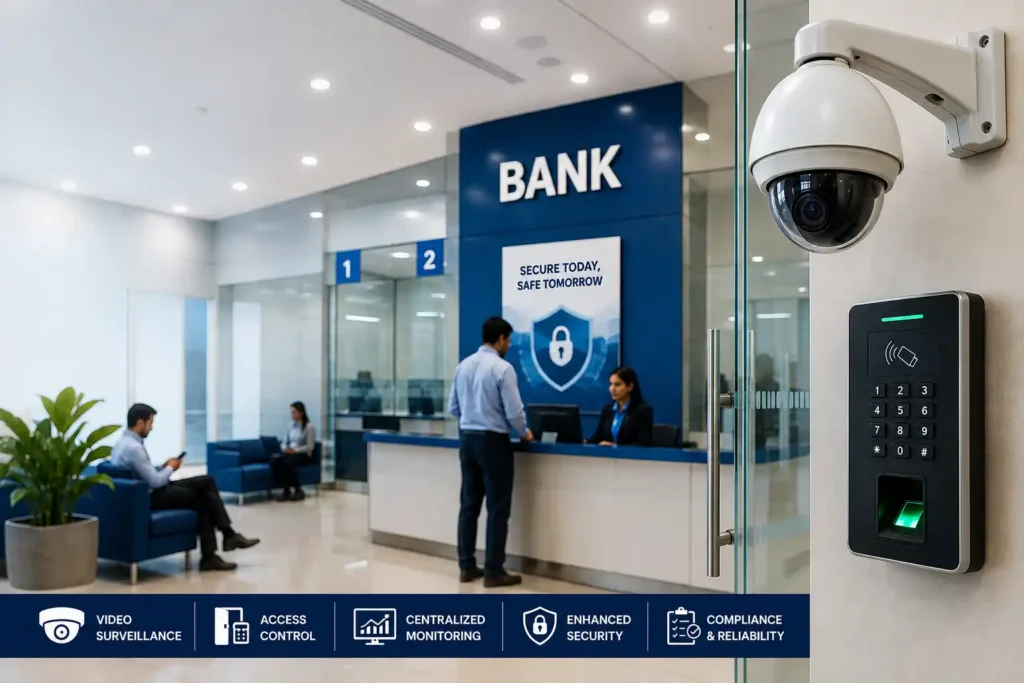
Integration means every access event — a door badge swipe, a biometric scan, a PIN entry — is tied directly to the corresponding camera feed, on a single timeline, in a single dashboard. For a bank or NBFC branch, this typically covers:
Video surveillance with intelligent analytics. IP cameras placed at entry points, teller counters, the locker area, and the cash room don’t just record — they can flag loitering near the vault, detect an unattended bag, or send an alert the moment someone lingers at an ATM after hours. This is a meaningful upgrade from older analog CCTV, which only stores footage for manual review after an incident has already occurred.
Role-based access control. Not every employee needs access to every room. Access control and elevator solutions let a branch define exactly who can enter the server room, the locker vault, or the cash processing area, at what times, and through what authentication method — RFID card, fingerprint, or facial recognition. If a staff member’s role changes or their employment ends, access can be revoked centrally in seconds rather than by physically re-keying locks.
Elevator and floor-level restrictions. For NBFCs and banks operating out of multi-storey commercial buildings, which is increasingly common in Mangalore’s business districts, elevator access control ensures visitors and vendors can only reach the floors they’re authorized for, rather than the entire building.
Centralized alerts and audit trails. Every access attempt, successful or denied, is logged and time-stamped alongside video evidence, giving compliance teams a ready-made audit trail instead of a scramble during inspection season.
Visitor and vendor management. Financial institutions deal with a steady stream of auditors, ATM technicians, and cash-in-transit staff. Digital visitor logs tied to access control remove the guesswork from “who was in the building and when.”
Know About ( Access control and elevator solutions)
The Compliance and Risk Angle
Physical security decisions for banks and NBFCs in India can no longer be made independently of regulatory expectations. RBI’s cybersecurity and IT governance directions increasingly treat branches, ATMs, vaults, and data centres as part of the same risk environment as core banking systems, with expectations around continuous monitoring and fast incident escalation. Add the compliance pressure building around the Digital Personal Data Protection (DPDP) Act, which governs how customer data — including video footage — is stored and retained, and it’s clear that surveillance and access control are no longer just loss-prevention tools. They’re a documented, auditable part of an institution’s compliance posture.
For a branch manager evaluating vendors, this raises the bar beyond “install some cameras.” The right partner needs to understand encrypted network design and structured access logs — building a system an auditor can review without friction, not just hardware mounted on a wall.
Why This Matters More for Mangalore's Growing Financial Sector
Mangalore has long been home to some of India’s oldest and largest banks, alongside a fast-expanding base of NBFCs, gold loan companies, and microfinance branches serving the coastal Karnataka and Malnad regions. As branch networks expand into semi-urban and rural pockets around Dakshina Kannada and Udupi, security infrastructure often struggles to keep pace — new branches open with baseline equipment, while integration and monitoring get pushed to “later.” That gap is exactly where incidents and compliance shortfalls tend to happen.
A locally supported, integrated network solution built for financial institutions closes that gap without requiring a full rip-and-replace of existing infrastructure. Encrypted IP voice systems for secure branch communication, video surveillance tied to access control, and redundant networking to keep monitoring live even during connectivity drops can all be layered onto what a branch already has, then scaled as new branches come online.
Institutions that have already modernized other parts of their security stack — from enterprise-grade network security postures to structured branch cabling — will find that adding integrated surveillance and access control is a natural next step rather than a separate project.
Conclusion
Banks and NBFCs in Mangalore and across coastal Karnataka are operating in an environment where physical security, cybersecurity, and regulatory compliance have effectively merged into one requirement. Disconnected cameras and standalone door locks no longer meet that bar. Integrated surveillance and access control — with role-based permissions, elevator restrictions, real-time alerts, and audit-ready logs — gives branch managers and compliance teams the visibility they need, while giving customers the confidence that their bank, and their money, is genuinely being watched over.
For financial institutions planning new branches or upgrading existing ones in Mangalore, ElectroCore Systems designs and deploys integrated security infrastructure built specifically for the compliance and operational realities banks and NBFCs face today.