

Campus Security Solutions in Mangalore
Walk into any school or college campus in Mangalore today and you’ll likely spot at least one visible security measure a CCTV camera at the gate, a guard’s logbook, maybe a PA speaker near the assembly ground. Paging systems have long been the backbone of campus communication, and for good reason: they push an emergency message to hundreds of students in seconds. But paging alone was never designed to answer a harder question who is actually inside your campus right now, and should they be?
That’s the gap institutions across Mangalore and Dakshina Kannada are being asked to close. Campus safety today isn’t a single-device problem. It’s a systems problem.
Table of Contents
Why a Paging System Alone Isn't "Campus Security"
A well-designed paging or intercom system, of the kind we covered in our guide on IP-based paging systems, is genuinely valuable — it handles bell schedules, lockdown alerts, and zoned announcements across buildings. Our earlier piece on the benefits of IP paging in modern buildings covers how these systems outperform legacy analog PA setups.
But paging only pushes information out. It doesn’t control who enters through the main gate, it doesn’t verify a visitor’s identity, and it doesn’t tell your administration whether a door was propped open after hours. Real campus safety requires those functions to sit on the same network and respond to each other automatically — not as isolated boxes bought from different vendors over the years.
Karnataka's Regulatory Push Is Changing the Baseline
This isn’t just good practice anymore — it’s becoming policy. Karnataka’s Higher Education Department has directed all affiliated colleges and universities in the state to install CCTV surveillance across campuses, a move aimed at curbing ragging, harassment, and unauthorised entry. CBSE separately amended its affiliation bye-laws in 2025 to make campus CCTV coverage mandatory for schools, with minimum retention periods for footage.
At the same time, the Digital Personal Data Protection (DPDP) Act, 2023 and its 2025 Rules changed what “compliant” surveillance looks like. Any footage or biometric record that identifies a student counts as personal data, which means schools and colleges are now expected to secure that data, limit who can access it, and — for younger students — document parental consent. A camera system installed purely to tick a compliance box, without proper access controls and secure storage around it, can end up creating the very liability it was meant to prevent.
For Mangalore’s schools and colleges, this means the conversation has shifted from “do we need cameras” to “how do all our systems work together, and who is accountable for the data.”
Know About ( IP Paging and Notification Systems)
What an Integrated Campus Security Stack Looks Like
A genuinely integrated setup layers several systems on a single IP network so they can trigger and inform each other:
Access control at every entry point. Instead of a manual gate register, RFID cards, mobile credentials, or biometric readers can restrict entry to authorised staff, students, and pre-approved visitors, with a digital log of every entry and exit. Our access control and elevator solutions are built around exactly this kind of multi-credential authentication, so a lost ID card or a resigned staff member’s access can be revoked centrally in seconds rather than left active for weeks.
IP video surveillance, not legacy analog CCTV. Modern IP cameras offer far better low-light performance, remote viewing from a phone, and motion-based alerts compared to older analog systems, as we explored in our guide to WiFi CCTV cameras. On a campus, this matters at hostel entrances, parking areas, and boundary walls where a human guard can’t watch every angle continuously.
Floor and zone restrictions for multi-storey buildings. Colleges with labs, server rooms, or administrative floors benefit from the same logic we described in elevator access control — restricting who can reach which floor, and logging every attempt, rather than relying on a lock and a guard’s memory.
Video intercoms at gates and hostels. A video door phone at a hostel entrance or campus gate lets staff visually verify a visitor before buzzing them in, and can route that call to a security office phone instead of requiring someone to be physically present at every gate.
A single network tying it all together. None of this works as isolated purchases. Paging, CCTV, access control, and intercoms need to sit on infrastructure engineered to carry them reliably, which is the case we make in our piece on cloud and network solutions — and increasingly, these systems are being made accessible through the same voice-enabled and app-based controls that campus administrators already use for other building functions.
Why Integration Matters More Than Any Single Device
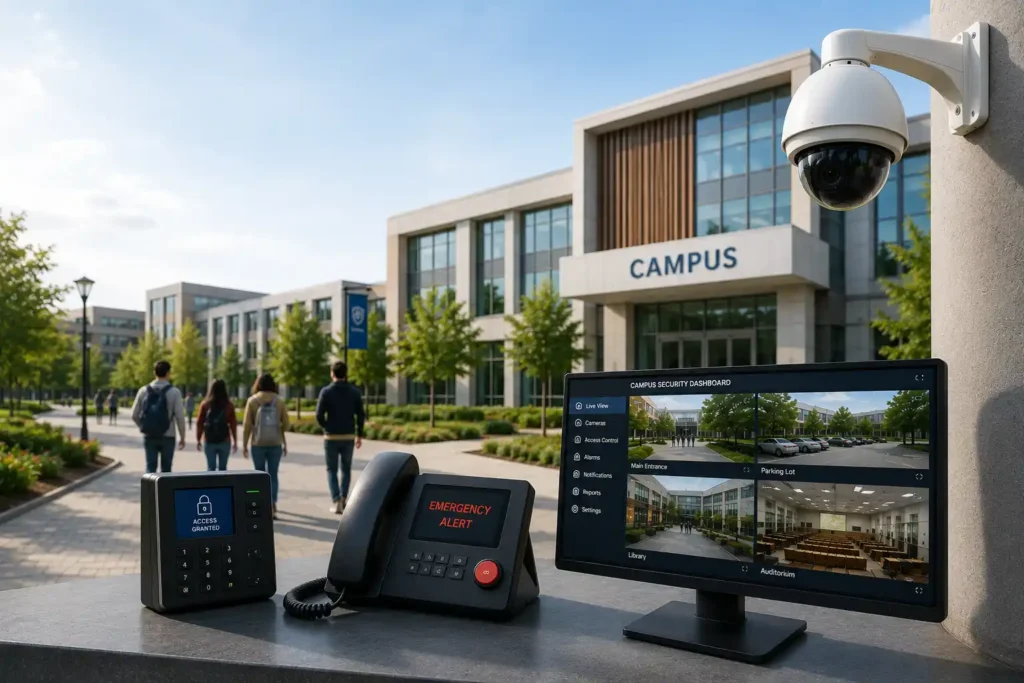
The real value shows up in how these systems talk to each other. A camera detecting motion at a locked gate after hours can trigger a paging announcement to the security desk. An access-control log showing a student badge used outside class hours can be cross-checked against camera footage from the same door. A centralized dashboard means your administration isn’t logging into four different apps from four different vendors to answer one question about who was where.
For a growing school or college campus in Mangalore — often spread across multiple blocks, hostels, and gates — this kind of unified visibility isn’t a luxury. It’s what turns a collection of security devices into an actual safety system.
Getting Started
Most institutions don’t need to rip out and replace everything at once. The practical starting point is an audit: which entry points have no access control, which cameras are outdated analog units with no remote access, and which buildings still rely on a single guard rather than a logged, monitored entry. From there, a phased rollout starting with main gates and hostel entrances brings the campus onto one integrated platform without disrupting the academic calendar.
ElectroCore Systems works with schools and colleges across Mangalore and Karnataka to design exactly this kind of layered, compliant security infrastructure — from access control and IP surveillance to the paging backbone that ties emergency response together. If your campus is still running these as separate systems, an integration audit is the logical next step toward genuinely safer grounds for students and staff alike.get in touch with our team