

retail surveillance
Shrinkage is one of those costs that rarely shows up as a single line item it shows up quietly, in inventory counts that never quite add up, in margins that erode a little more every quarter, and in stock write-offs that get explained away as “wastage.” Yet across India, retailers lose a meaningful share of revenue to theft, billing errors, and process failures every year, with industry benchmarks placing the country among the higher-shrink markets in the Asia-Pacific region. For a multi-outlet retail chain or a media/broadcast facility handling high-value equipment, that loss compounds fast and it’s largely preventable with the right surveillance infrastructure.
IP-based video surveillance has moved well past its original role as a passive deterrent. Modern network cameras, when properly deployed and integrated, do two jobs at once: they protect the business from loss, and they generate operational and customer insight that traditional CCTV was never built to deliver. For retail chains, showrooms, and media operations across Karnataka and the rest of India, this dual capability is becoming a core part of how stores compete — not just how they stay secure.
Table of Contents
Why Shrinkage Is a Bigger Problem Than Most Retailers Realize
Retail shrinkage in India is frequently reported in the range of roughly 1.2% to over 3% of annual revenue, depending on the format and the strength of existing controls a figure that sounds small until it’s applied to actual store revenue. For a chain generating ₹2 crore a month per outlet across even a modest number of stores, that percentage can translate into lakhs of rupees disappearing every month without ever appearing as a clear, traceable event. The causes are rarely a single dramatic theft; they’re usually a mix of shoplifting, employee-linked losses such as under-ringing or “sweethearting” at billing counters, vendor and delivery discrepancies, and administrative errors that never get reconciled.
Traditional loss-prevention methods — floor walkers, spot audits, and exception-based point-of-sale reports only catch the visible fraction of this problem. They rely on someone noticing an anomaly after the fact, by which point the loss has already occurred and the trail has usually gone cold. This is precisely the gap that a well-designed IP surveillance system is built to close. Retail Surveillance
How IP Cameras Actively Reduce Shrinkage
Unlike analog CCTV, IP network cameras deliver high-resolution footage, wide dynamic range for tricky lighting, and the ability to integrate directly with point-of-sale systems, access control, and video management software. That integration is where the real loss-prevention value comes from:
POS-linked video verification. By syncing camera feeds with billing terminals, every transaction can be matched to a corresponding video clip. Under-ringing, no-rings, and unauthorized discounts become immediately visible during review rather than surfacing only in a quarterly stock reconciliation.
Coverage of high-risk zones. Entrances, billing counters, stockrooms, and receiving docks each carry different risk profiles. Properly placed IP cameras with night vision and wide-angle lenses give consistent coverage across all of them, closing blind spots that analog systems typically leave behind.
Real-time alerts and remote monitoring. Modern video management platforms can flag unusual activity — extended loitering near high-value shelves, after-hours movement in stockrooms, or repeated returns processed by the same till — and push alerts to store or regional managers instantly, rather than waiting for someone to review archived footage.
Multi-outlet visibility from one dashboard. For retail chains with several locations, centralized surveillance management means a regional loss-prevention team can monitor every store from a single interface instead of relying on siloed, property-level systems — the same principle that has already proven effective for hotel and resort operators managing multi-property security.
Deterrence at the point of decision. Visible, well-placed cameras change behavior before an incident happens. Employees and customers alike act differently when they know coverage is comprehensive rather than symbolic — which is often the single most cost-effective form of loss prevention available.
Know About (IP Cameras)
Beyond Loss Prevention: Turning Cameras into a Customer Insight Tool
The same camera network that protects inventory can also generate data that retail and media businesses rarely capture through any other channel:
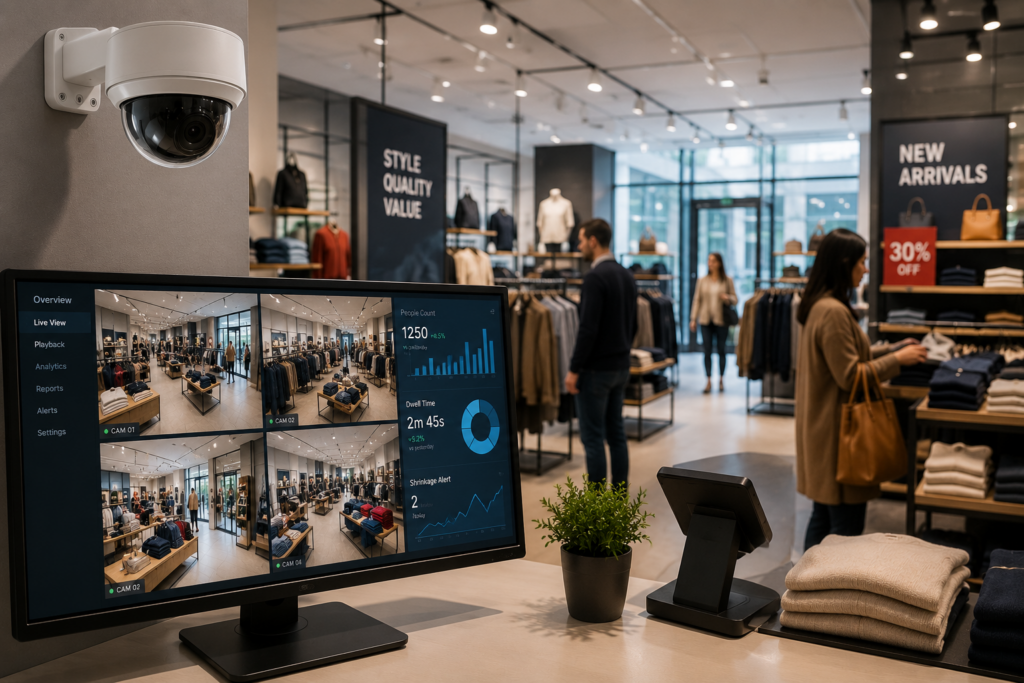
- Footfall and dwell-time analysis — understanding how many customers enter a store, which sections attract the most attention, and how long they linger helps merchandising and staffing decisions become data-driven rather than intuition-based.
- Queue and peak-hour monitoring — camera-based analytics can flag when billing counters are approaching capacity, allowing managers to open additional counters before service quality drops.
- Layout and display effectiveness — heat-mapping foot traffic around promotional displays gives retailers a concrete way to measure whether a layout change or campaign is actually working, rather than guessing from sales totals alone.
- Staff coverage and response times — for media facilities and large-format retail, video data can highlight gaps in staff presence on the floor, supporting better scheduling and training decisions.
This is the shift that separates a modern IP surveillance deployment from a legacy CCTV installation: the cameras stop being a cost center that only matters after something goes wrong, and start contributing directly to operational and commercial decisions.
Building an Integrated Security Ecosystem
Video surveillance delivers the most value when it isn’t operating in isolation. When IP cameras run on the same infrastructure as access control and IP paging systems, retail and media operations gain a genuinely unified security layer: access logs can be cross-referenced against footage, staff can be paged instantly when a camera flags unusual activity, and a single networking backbone supports cameras, communications, and Wi-Fi without one system degrading the performance of another.
For retail chains and media facilities specifically, this integration also supports scale. A single-store deployment and a fifty-store rollout require the same underlying design principles — correct camera placement, adequate bandwidth planning, and NVR or cloud storage sized to retention requirements — just applied at different scale. Businesses that plan for this from the outset avoid the common pitfalls of patchy coverage, insufficient storage, and systems that can’t grow with the business.
Conclusion
Shrinkage doesn’t announce itself — it accumulates silently until a quarterly inventory count forces the conversation. IP-based video surveillance gives retail and media businesses a way to get ahead of that conversation: catching loss events as they happen, deterring the behavior that causes them, and generating footfall, dwell-time, and operational data that traditional security systems were never designed to produce. Combined with access control and communication systems on a single network, surveillance stops being a standalone security expense and becomes a genuine driver of both loss prevention and customer insight.
If you’re looking to reduce shrinkage and gain better visibility into how customers move through your stores or facilities, Electro Core Systems designs and deploys end-to-end IP surveillance solutions tailored to retail and media environments — from network assessment through installation and ongoing support. Get in touch with our team to discuss a surveillance solution built for your business.
For more insights on IP surveillance, Retail Surveillance, networking, and communication infrastructure, explore our blog for additional guides and case studies.