

Smart Residential Security
Indian housing is changing shape. Nuclear families, dual-income households, and a steady migration into apartment complexes and gated townships have made “who’s at the gate” a question that residents want answered instantly, not after a guard finishes a phone call. Industry estimates project that gated communities across India’s top 50 cities will house around 24 million households by 2026, roughly double the number from 2021 and security is consistently cited as the single biggest reason families choose gated living over standalone homes.
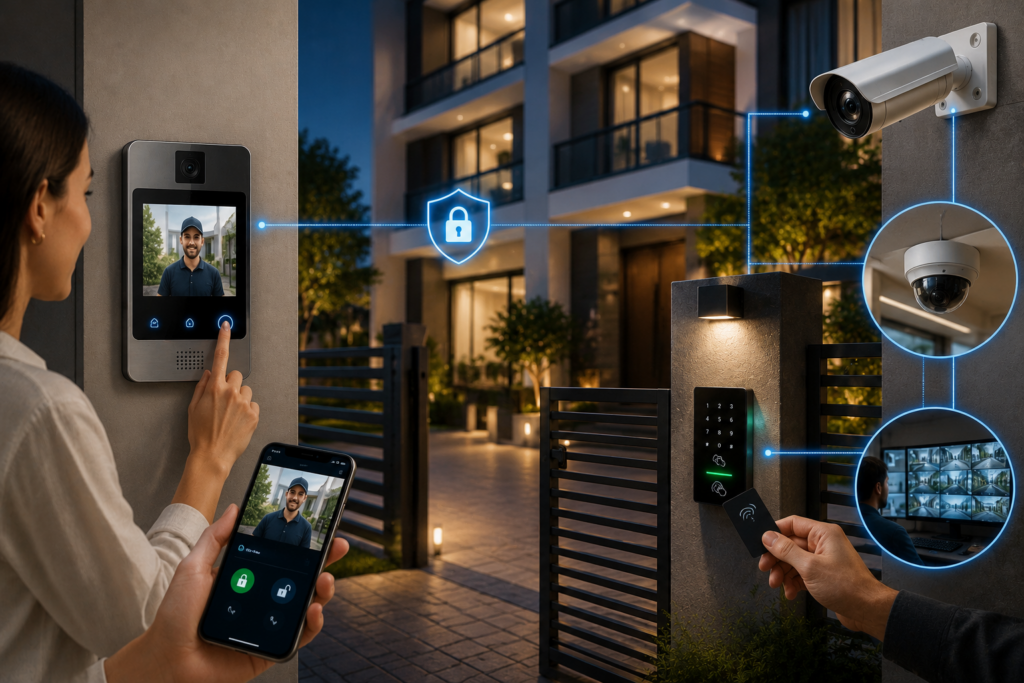
That demand has pushed residential security past the single-guard-and-logbook model. Today’s apartment complexes, villa communities, and housing societies are combining three technologies video door phones, network cameras, and access control systems into one connected security layer. Done well, this integration doesn’t just deter intruders; it changes how residents, security staff, and facility managers experience daily life on the property.
This post breaks down what each component does, why combining them matters more than deploying them in isolation, and what to consider before you invest in a smart security upgrade for your residential property.
Table of Contents
Why Residential Security Can No Longer Work in Silos
A decade ago, most Indian residential complexes treated security as three separate purchases: an intercom for the main gate, a handful of CCTV cameras for the parking lot, and a security guard with a visitor register. Each system worked on its own, and none of them talked to each other. A camera might catch a face, but there was no record of when that person entered, which resident approved them, or which door they used afterward.
That gap matters. According to a recent industry market analysis, the residential segment of India’s electronic security market is now the fastest-growing end-user category, expanding at a projected compound annual growth rate of nearly 13% through 2031 — faster than the government, retail, or industrial segments. Much of that growth is coming from properties replacing standalone equipment with connected access control, surveillance, and communication systems that share data on a common network.
An integrated approach means a visitor’s photo captured at the video door phone can be logged alongside the entry timestamp from the access control panel and cross-referenced with the nearest camera feed all from a single dashboard the facility manager or resident welfare association (RWA) can access from a phone. That’s a fundamentally different level of accountability than three disconnected systems ever provided.
Video Door Phones and Intercoms: The First Point of Contact
For most residents, the door phone is the most visible piece of a security system, because it’s the one they interact with every day. Modern IP-based video door phones have moved well beyond the buzzer-and-speaker units of a decade ago. Today’s systems typically offer:
- Live video verification before a gate or door is unlocked, so residents can see exactly who is requesting entry
- Two-way audio and video calling routed to a resident’s smartphone, not just an in-home handset, so approvals don’t depend on someone being home
- Visitor logging that timestamps every call, whether it was answered, and whether entry was granted
- Integration with the building’s IP network, allowing the same door phone infrastructure to support intercom calls between units, security desks, and management offices
For apartment complexes specifically, this solves a problem that dogs high-rise living: delivery volumes have grown sharply with e-commerce and quick commerce, and every unmanaged delivery approval is either a security gap or a bottleneck at the gate. A networked door phone system lets security staff or residents clear routine visitors quickly while still keeping a verifiable record of who came in and when.
Network Cameras: Coverage That Actually Gets Used
Cameras are the most commonly deployed piece of residential security, but coverage alone isn’t the same as protection. A property with forty cameras and no one monitoring them, no searchable footage, and no integration with access events is not meaningfully safer than a property with ten well-placed, properly managed ones.
The shift worth paying attention to is toward IP-based network cameras with video management software (VMS) rather than isolated analog CCTV. This matters for residential properties in a few concrete ways:
- Centralized, searchable footage — instead of pulling tapes or scrubbing through hours of DVR recordings, management can search by time, camera, or motion event across the entire property
- Cloud or hybrid storage that protects footage even if on-site hardware is damaged or tampered with
- Motion and perimeter alerts that notify security staff in real time rather than relying on someone watching a bank of monitors
- Coverage of the areas residents actually worry about — entry gates, parking structures, lift lobbies, children’s play areas, and perimeter walls — rather than blanket coverage that generates more footage than anyone can review
Affordable AI-enabled camera hardware and mobile app control have been key drivers of residential camera adoption over the past few years, making features like facial recognition alerts and license plate capture — once reserved for large commercial sites — realistic for mid-sized residential complexes too.
Know About (Cameras, and Access Control)
Access Control: Moving Beyond Keys and Manual Registers
Access control is the piece that turns a security system from “watch and record” into “watch, record, and restrict.” Where door phones verify identity and cameras provide evidence, access control decides who is physically allowed through a door, gate, or lift — and it’s usually the most operationally impactful upgrade a residential property can make.
Common formats for residential access control include RFID cards or fobs for resident entry, biometric fingerprint or facial recognition systems for staff and service personnel, and app-based mobile credentials that let residents unlock gates, lobbies, or lifts directly from their phones, with the option to issue time-limited digital passes to guests or delivery staff. For multi-tower complexes, access control commonly extends into elevator solutions, so that a resident’s credential restricts which floors a lift will serve — a detail that matters for both security and building management in mixed-use or high-density properties.
The operational win here is auditability. Every entry becomes a logged, timestamped event tied to a specific credential, which matters when an RWA needs to investigate a complaint, verify staff attendance, or simply confirm that a maintenance visit actually happened.
Why Combining All Three Delivers More Than the Sum of Its Parts
Individually, a door phone, a camera network, and an access control system each solve a narrower problem. Combined on a shared network infrastructure, they solve a bigger one: giving residents, security staff, and property managers one coherent picture of who is on the property, why, and when.
A practical example: a delivery rider arrives at the main gate. The door phone captures video and routes the call to the resident’s phone for approval. Once approved, the access control system logs the credential or one-time code used to open the gate. The nearest camera captures footage of the rider entering and exiting the lift lobby. If a package goes missing later, management doesn’t need three separate systems and three separate staff members to reconstruct events — it’s one searchable trail.
This kind of integration depends on solid underlying infrastructure. Door phones, IP cameras, and access control panels are all network devices, and a property with weak Wi-Fi coverage or poorly planned cabling will see the same problems that show up in any enterprise network security deployment: dropped connections, delayed alerts, and footage gaps at exactly the moments they matter most. For larger residential developments, this often means planning structured cabling across the property before device installation, not after.
Conclusion
Residential security in India has moved past standalone gadgets. The properties seeing the biggest gains in resident safety and peace of mind are the ones treating video door phones, network cameras, and access control as one connected system rather than three separate purchases. That integration turns raw footage and access logs into something far more useful: a clear, searchable record of who came and went, and a faster, more reliable way for residents and staff to respond when it matters.
Whether you’re managing a villa community, a mid-rise apartment block, or a large gated township, the underlying principle is the same plan the network first, then layer communication, surveillance, and access control on top of it, with a partner who can support all three.
Electro Core Systems designs and deploys integrated residential security from video door phones and IP camera networks to access control and elevator solutions — for apartment complexes, villas, and gated communities across Mangalore and Karnataka. Get in touch to discuss a security upgrade for your property, or browse our blog for more insights on communication and security infrastructure.